
👑 THE FEAST OF TABERNACLES (SUKKOT) For The New Covenant Saint 🌾
Sep 25, 2026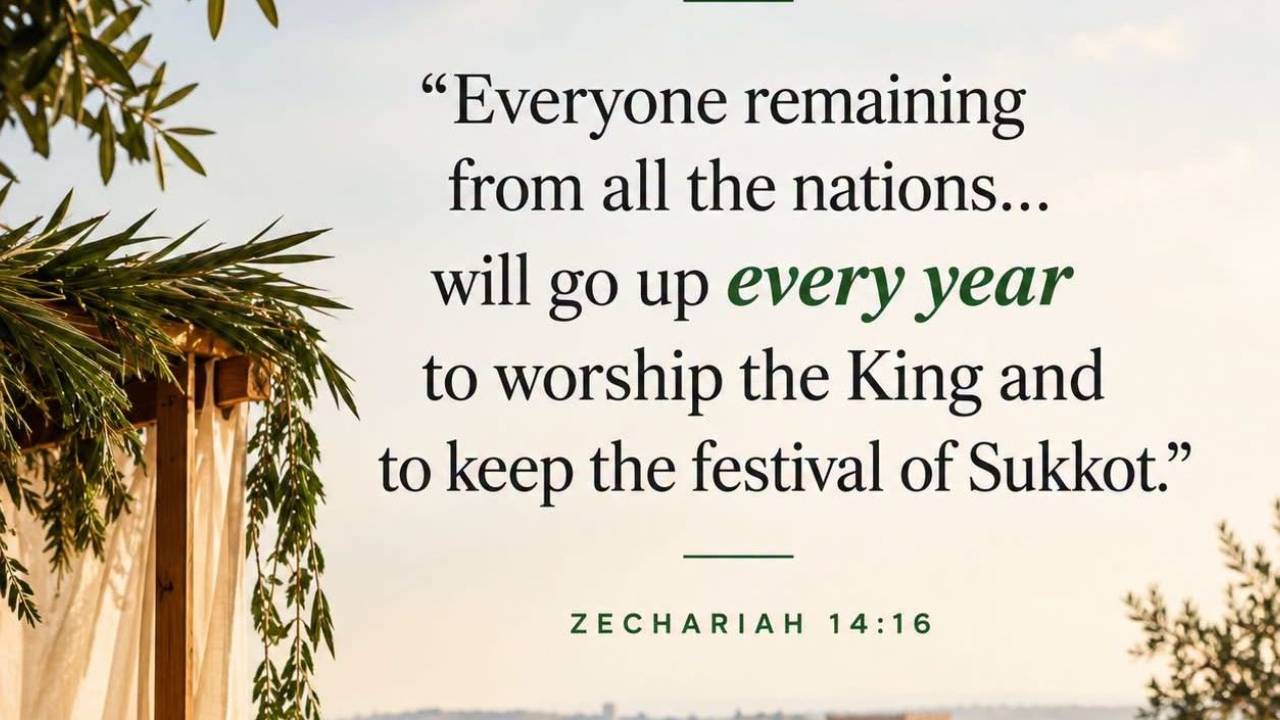
What if Sukkot is more than a remembrance… but a glimpse into the future Kingdom?
“Everyone remaining from all the nations… will go up every year to worship the King and to keep the festival of Sukkot.”
📖 Zechariah 14:16
Have you ever stopped to consider what this prophecy actually says about Sukkot?
Zechariah describes a future time when the nations will go up to Jerusalem every year to worship the King and keep the Feast of Sukkot. And the passage continues with a serious warning.
If a nation refuses to go up to Jerusalem to worship the King and keep Sukkot, Zechariah says that no rain will fall on them. Egypt is specifically mentioned, and the passage describes punishment for the nations that refuse to keep the feast.
📖 Read Zechariah 14:16–19 for yourself.
This raises an important question:
If Sukkot appears in King Jesus’ picture of the future, what does that tell us about the biblical feasts?
Sukkot isn’t presented here as merely something from Israel’s ancient past. Zechariah places it within a future prophetic setting involving the nations.
So open your Bible and read the passage in context.
Had you ever noticed this before?
Sukkot: Why Would New Covenant Saints Observe It?
If this feast was given to Israel, why would New Covenant Saints (grafted into Israel) observe it? That question deserves an honest answer.
Torah gives the Lord's appointed times to Israel. But Scripture does not teach that New Covenant Saints who come to Israel’s Messiah form a separate people with a separate faith.
Paul tells New Covenant Saints to remember what they once were: excluded from the commonwealth of Israel and strangers to the covenants of promise. Through Yeshua’s blood, they have been brought near. They are now “fellow citizens with God’s people and members of God’s household” (Eph 2:11–19).
Romans 11 gives us another picture.New Covenant Saints are branches grafted into Israel’s olive tree. We do not replace the natural branches, and the Lord does not uproot Israel to plant a new tree. We are grafted in and begin sharing in the nourishing root.
That belonging has a shape.
We have not been brought near merely to admire Israel’s Scriptures and appointed times from a distance.
Sukkot itself includes the outsider in its rejoicing. Deut 16:13–15 names the foreigner alongside the household, the Levite, the orphan and the widow. The wider Torah establishes one standard for the native-born and the outsider dwelling among Israel (Num 15:15–16).
Lev 23:42 specifically tells native-born Israelites to dwell in sukkot.
We should acknowledge that no verse says, word for word, “Every New Covenant Saint today must build a sukkah.” But that verse should not be separated from the rest of Scripture. Zech 14:16–19 even looks ahead to people from the nations going up to worship the King and celebrate Sukkot.
Taken together, we believe New Covenant Saints who have been grafted into Israel should observe Sukkot, including dwelling in a temporary shelter as circumstances allow (get our GUIDE to discover other ways to celebrate this feast without a physical Sukkah - https://www.amazon.com/dp/B0HJGJXLX4 ).
The sukkah is not just decoration.
It is the act that the Lord gave to preserve the memory of Israel’s wilderness journey and His care for them.
We do not build one to become Jewish, replace Israel or earn salvation. We build because Yeshua has brought us near. We now share in Israel’s Messiah, promises and hope.
And when Friday(26th September) sunset comes, we will step into that temporary shelter and remember.
Sukkot: The GREAT Feast of the King
When we trace Sukkot from its original meaning in the wilderness through the Prophets, other ancient writings concerning the coming Kingdom, and the signs pictured in the heavens, a remarkable prophetic picture begins to emerge.
Sukkot appears to portray the great ingathering of the redeemed to their King, the seven-day Marriage Feast of the Lamb, and the Messianic Kingdom in which the Lion of Judah reigns with His Bride while Scripture describes living water flowing, the nations coming before the King, creation experiencing restoration and abundance, and YHWH dwelling among His people.
This is a picture that moves from redemption to gathering, from gathering to celebration, from celebration to marriage, from marriage to kingship, and from kingship to dwelling with God.
Let us follow the thread.
The Great Ingathering of the Redeemed
Sukkot is connected to the gathering in of the harvest.
Exodus 23:16; 34:22 — Sukkot is the Feast of Ingathering, when the harvest is gathered in.
And Scripture gives us another prophetic dimension to harvest:
Matthew 13:39–43 — The harvest is the end of the age, when the messengers gather.
Then we see the sound of the trumpet:
Matthew 24:31 — A great trumpet sounds and His elect are gathered.
And again:
1 Thessalonians 4:16–17 — The trumpet of Elohim sounds and the redeemed are caught up to meet the Master.
The imagery is striking.
The Feast of Ingathering speaks of harvest being gathered. Scripture speaks of a harvest at the end of the age. A great trumpet sounds, and His elect are gathered. The trumpet of Elohim sounds, and the redeemed are caught up to meet the Master.
The picture is one of gathering. The redeemed are being brought together to their King. And that brings us to another remarkable connection.
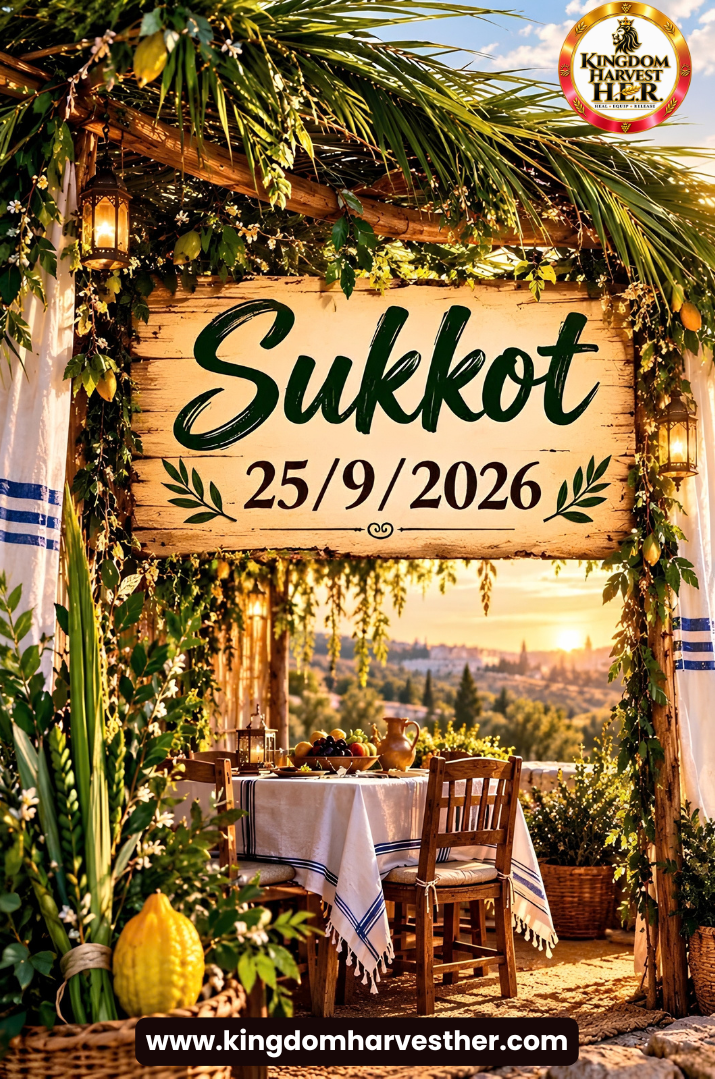
The Seven-Day Marriage Feast
Sukkot is not only a feast of gathering. It is a seven-day feast.
Leviticus 23:34 — Sukkot is a seven-day Feast to YHWH. Deuteronomy 16:13–15 — Seven days of feasting and rejoicing.
Now look at the biblical pattern of wedding celebrations.
Genesis 29:27–28 — Jacob fulfills the wedding week.
Judges 14:10, 17 — Samson's wedding feast lasts seven days.
Joseph and Aseneth — Joseph and Aseneth are crowned and joined in marriage, followed by a seven-day wedding celebration.
Then we arrive at the breathtaking prophetic picture in Revelation:
Revelation 19:7–9 — The marriage of the Lamb is come, His Wife has made herself ready, and the invited are called to the Marriage Supper of the Lamb.
Sukkot is a seven-day feast marked by rejoicing. The Scriptures also give us a pattern of seven-day wedding celebrations. And Revelation brings us to the ultimate wedding:
The Marriage of the Lamb.
The King Receives His Bride
The picture becomes even more beautiful when we follow the theme of the King receiving His Bride.
Psalm 45:6–15 gives us:
King → throne → righteous scepter → Queen → virgins → rejoicing → King's palace.
Then we see Esther.
Esther 2:2–18 — Virgins gathered → preparation → favor → King loves Esther → crown → Queen → great feast.
Then Yeshua gives us this kingdom picture:
Matthew 22:2 — The kingdom of heaven is likened to a King making a marriage for His Son.
And again:
Matthew 25:1–10 — Virgins → Bridegroom comes → they go out to meet Him → those who are ready enter the marriage.
And Revelation declares:
Revelation 19:7 — His wife hath made herself ready.
There is preparation.
There is a Bride.
There is a King.
There is a wedding.
And there is a feast.
The Lion of Judah Reigns
The Bridegroom is not merely coming as a bridegroom.
He is the King.
The Lion.
The One who reigns.
Genesis 49:9–10 — Judah is the Lion → the scepter remains with Judah → the peoples are brought under his rule.
Then Revelation identifies Him:
Revelation 5:5 — Yeshua is the Lion of the tribe of Judah.
And when He appears:
Revelation 19:11–16 — The Bridegroom appears as the returning Warrior-King, the King of Kings.
The reign is then described:
Revelation 20:4–6 — Messiah and His set-apart ones reign a thousand years.
And Zechariah declares:
Zechariah 14:9 — And Yeshua shall be King over all the earth.
The One who gathers His Bride is the One who reigns.
The One who comes for the wedding is the King.
The Lion of Judah reigns.
And the promise to those who overcome remains:
Revelation 3:21 — Those who overcome sit with Messiah in His throne.
Revelation 20:4–6 — His people live and reign with Messiah for a thousand years.
Living Water Flows
The picture of Sukkot also carries the imagery of water.
It begins in the wilderness.
The wilderness — The Lord gives His redeemed people water from the rock.
Then Isaiah declares:
Isaiah 12:3 — With joy shall ye draw water out of the wells of salvation [yeshuah].
And then something remarkable happens during Sukkot itself.
John 7:37–39 — During Sukkot, King Jesus cries, If any man thirst, let him come unto me, and drink, speaking of the Spirit.
The connection reaches forward into the coming Kingdom:
Zechariah 14:8 — In the coming Kingdom, living waters go out from Jerusalem.
From the wilderness comes water.
From salvation comes water.
During Sukkot, Yeshua speaks of coming to Him and drinking.
And in the coming Kingdom, living waters flow from Jerusalem.
Living water flows.
The Nations Come Before the King
And who is present in this future Kingdom picture?
The nations.
Zechariah 14:9 — King Jesus is King over all the earth.
Zechariah 14:16 — The surviving nations go up to worship the King.
And what do those same nations do?
Zechariah 14:16 — Those same nations keep the Feast of Sukkot.
The progression is remarkably simple:
King → nations → worship → Sukkot.
Sukkot therefore appears within the prophetic picture of the nations coming before the King.
Restoration, Harvest and Abundance
Sukkot is also a feast of harvest and rejoicing in provision.
Deuteronomy 16:13–15 — The harvest has been gathered in and YaHuWaH's people rejoice in His provision.
Then Amos gives us a powerful restoration picture:
Amos 9:11 — The Lord raises the fallen sukkah of David.
And the verses that follow paint an extraordinary picture:
Amos 9:13–15 — Plowman → reaper → mountains dripping sweet wine → vineyards → gardens → fruit → restored people.
The Prophetic picture being : Messiah is revealed → extraordinary harvest → vines → wine → food → rejoicing.
Harvest.
Restoration.
Fruitfulness.
Abundance.
Rejoicing.
The Feast of Ingathering points us toward a picture in which what was scattered is gathered, what was fallen is restored, and the earth experiences abundance.
King Jesus Dwells Among His People
Perhaps one of the most beautiful threads running through Sukkot is the meaning of dwelling.
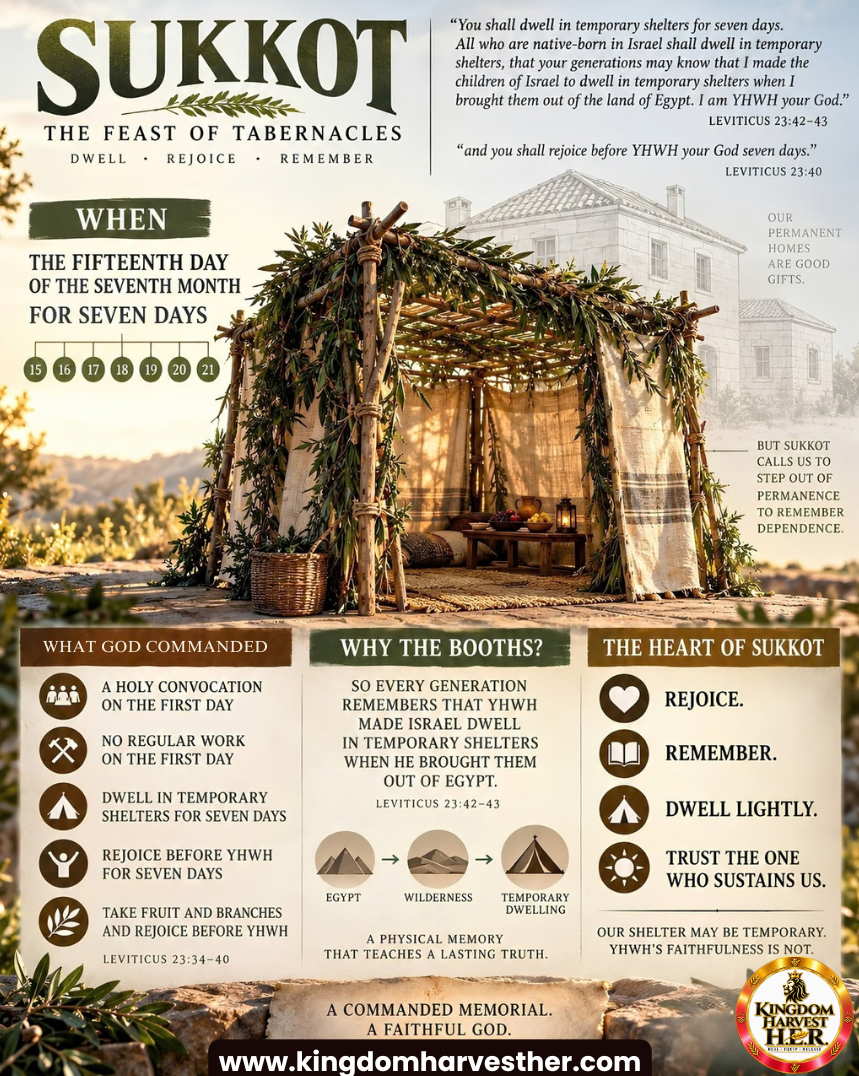
Sukkot itself remembers the wilderness journey and how The Lord caused His redeemed people to dwell in temporary shelters.
Leviticus 23:42–43 —The Lord brought Israel out of Egypt and caused His redeemed people to dwell in sukkot.
But the desire of King Jesus to dwell among His people reaches much further.
Exodus 25:8 — Let them make me a sanctuary; that I may dwell among them.
Then Ezekiel gives us a prophetic picture of gathering and dwelling:
Ezekiel 37:21–28 — gathered from the nations → one people → one King and Shepherd → covenant of peace → sanctuary → My tabernacle also shall be with them.
And Revelation gives us another extraordinary picture:
Revelation 7:9–17 — Great multitude → throne → palms → salvation → tabernacle spread over them → living water.
Then we come all the way back to Yeshua:
John 1:14 — The Word became flesh and tabernacled among us.
The God who dwelled with His people in the wilderness.
The God who said, “Let them make me a sanctuary; that I may dwell among them.”
The God whose tabernacle is promised among His gathered people.
The Word who became flesh and tabernacled among us.
The story is ultimately about God dwelling with His people.
From Ingathering to the Wedding Feast
When we step back and look at the entire picture, something remarkable emerges.
From the Ingathering to the Wedding Feast.
From the Lion to the King and His Bride.
From living water to the restoration of the earth.
From the wilderness sukkot to the promise:
“My tabernacle also shall be with them.”
Sukkot brings these prophetic pictures together, pointing toward the coming Kingdom when the redeemed are gathered to their King and He dwells among His people. (Read more about how to celebrate this great feast as a New Covenant Saint - https://www.amazon.com/dp/B0HJGJXLX4 ).
Conclusion
Perhaps, then, Sukkot is more than a remembrance.
Perhaps it is a prophetic rehearsal.
A remembrance of where we have come from.
A celebration of the One who has redeemed us.
A picture of the gathering of the nations.
A glimpse of the Bride made ready.
A proclamation of the reign of the King.
A reminder that living water flows from Him.
A declaration of restoration, harvest and abundance.
And a foretaste of the day when King Jesus dwells among His people.
The Feast of Tabernacles invites us to remember the wilderness—but it also causes us to lift our eyes toward the Kingdom.
Because the story does not end in the wilderness.
The redeemed are being gathered.
The Bride is being made ready.
The King is coming.
The nations will come before Him.
The Lion of Judah will reign.
Living waters will flow.
The earth will experience restoration.
And the King will dwell among His people.
Sukkot points us toward the coming Kingdom.
The King is coming.
The Bride is preparing.
The nations are gathering.
And the King will dwell among His people.
Rise. Return. Reign.
Stay Connected With News, Updates Or Book Your Free Strategy Session NOW (LIMITED TIME OFFER)!
