
📖 YOM KIPPUR for the NEW COVENANT Saint! 🎉
Sep 21, 2026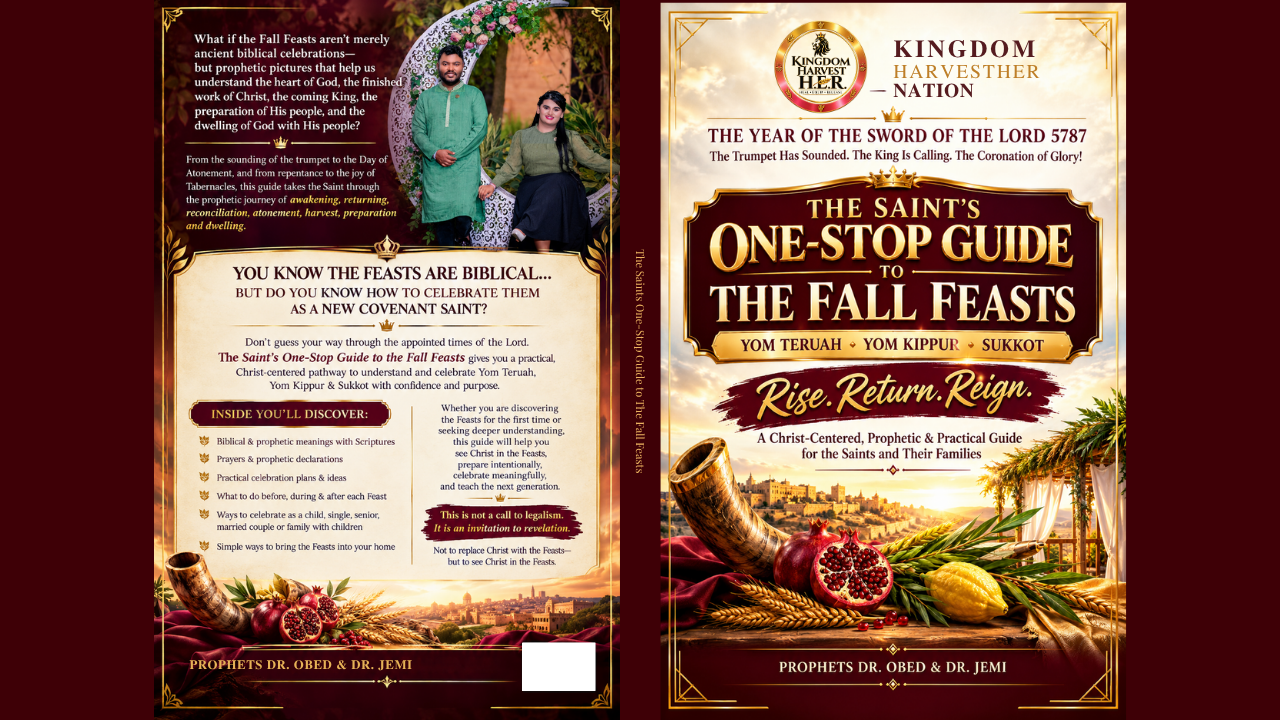
As with many biblically based holidays, Yom Kippur is first mentioned in the book of Leviticus, specifically Leviticus 16. Further, it is one of the three FALL FEASTS that God ordained as an everlasting ordinance(more in our book - https://www.amazon.com/dp/B0HJGJXLX4 .
Two blessings, two meanings.
“Yom Kippur” is 25 hours without food or water.
The second is bigger. Scholars says the year is written on Rosh Hashanah and sealed on Yom Kippur. Ten days between the writing and the signature. “To be sealed in the Book of Life for good” is to wish someone a year that holds.
Yom means 'Day' and Kippur means 'Atonement' and it can sound complicated, especially for Christians if we were never taught about it.
But it is one of Adonai’s seven appointed holy days, which He tells His people to keep throughout their generations.
And while the meaning of Yom Kippur is deep, the invitation is something we can understand:
to stop, humble and afflict ourselves before Him, examine our hearts, repent, rest, gather, and remember the seriousness of sin and the mercy of atonement.
So, this appointed day on God’s calendar is also known as the Day of Atonement. Yom Kippur served as the yearly cleansing of sin for the priests and all of God’s people–a time for repentance, returning to God. It is a moed—an appointed time.
- “‘This shall be a statute forever for you: In the seventh month, on the tenth day… you shall afflict your souls, and do no work… whether a native of your own country or a stranger… For on that day the priest shall make atonement for you… that you may be clean from all your sins before the Lord. It is a sabbath of solemn rest… the priest, who is anointed and consecrated to minister as priest in his father’s place, shall make atonement… he shall make atonement for the Holy Sanctuary… the tabernacle of meeting and the altar… for the priests and for all the people of the assembly. This shall be an everlasting statute for you, to make atonement for… all their sins, once a year.’ …” —Leviticus 16:29-34
Originally, sacrifices were made before God as part of His ordinance. Two goats were chosen for a portion of the sacrifices, and a lot was cast between the two. One goat would be sacrificed to God, while the other—the scapegoat—would have the sins of the people placed upon it before being released into the wilderness.
As Saints, we know that through Yeshua’s sacrifice, He not only became our Passover Lamb, He became our Yom Kippur scapegoat—He became sin for us—taking our sin far from us 2 Corinthians 5:21.
Because our Lord Jesus, Yeshua, became sin for us by His death, the blood of bulls and goats is no longer needed for the remission of our sins. Yet, this moed of Yom Kippur still serves as a most holy and meaningful day for us—an appointed time in this season that God has set before us as an opportunity to return to Him and realign with Him.
- “For if the blood of bulls and goats… sanctifies for the purifying of the flesh, how much more shall the blood of Christ, who through the eternal Spirit offered Himself without spot to God, cleanse your conscience from dead works to serve the living God?” —Hebrews 9:13-14
ORDINANCE of the GOD OF ISRAEL
As we are in Yom Kippur, consider the ways you need to return to God. In what ways does your church need to return? Tragically, the stain of replacement theology and antisemitism has ravaged many churches, and God is calling for corporate repentance.
The Church must return to Him, the God of Israel. We have been cut off from our inheritance, and it has cost us. God wants to restore life to His Bride, and it begins with repairing the breach between Israel and the Church!
Ask God to search your heart on this issue and pray for your brothers and sisters worldwide–may many more Christians come to repentance and experience the revelation of God's eternal covenant with Israel and all those grafted in (Romans 11).
May we navigate media headlines and news stories with discernment, prophetic understanding and a desire for truth.
The Old Testament continues into the New—you are grafted into Israel’s story, and there is more God wants to reveal to you about your spiritual heritage. Amen.
Is this Fast just a JEWISH FAST?
So for Saints in Yeshua, this day is not meaningless or “only Jewish.”
Romans 11 teaches that Gentile Saints have been grafted in. We have not replaced Israel, but through Messiah we have been brought near and invited into the richness of what Adonai has been teaching His people all along.
Yom Kippurim reminds us that:
Sin is serious.
Repentance matters.
Atonement is costly.
Mercy is extraordinary.
It is a set-apart time to slow down before Adonai, let Him search our hearts, confess what needs confessed, and make right what needs made right.
And it points forward, too.
Yom Kippur also reminds us that a day of judgment is coming. One day, every person will stand before Him. For Saints in Yeshua, that reality should produce reverence, sobriety, humility, gratitude and an earnest expectation.
Yeshua is our great High Priest and our atonement. Because of Him, we are not left striving to earn forgiveness. But His sacrifice should never make us casual about sin. It should make us all the more eager to repent(renew our minds) and walk in obedience.
FASTING according to the WORD
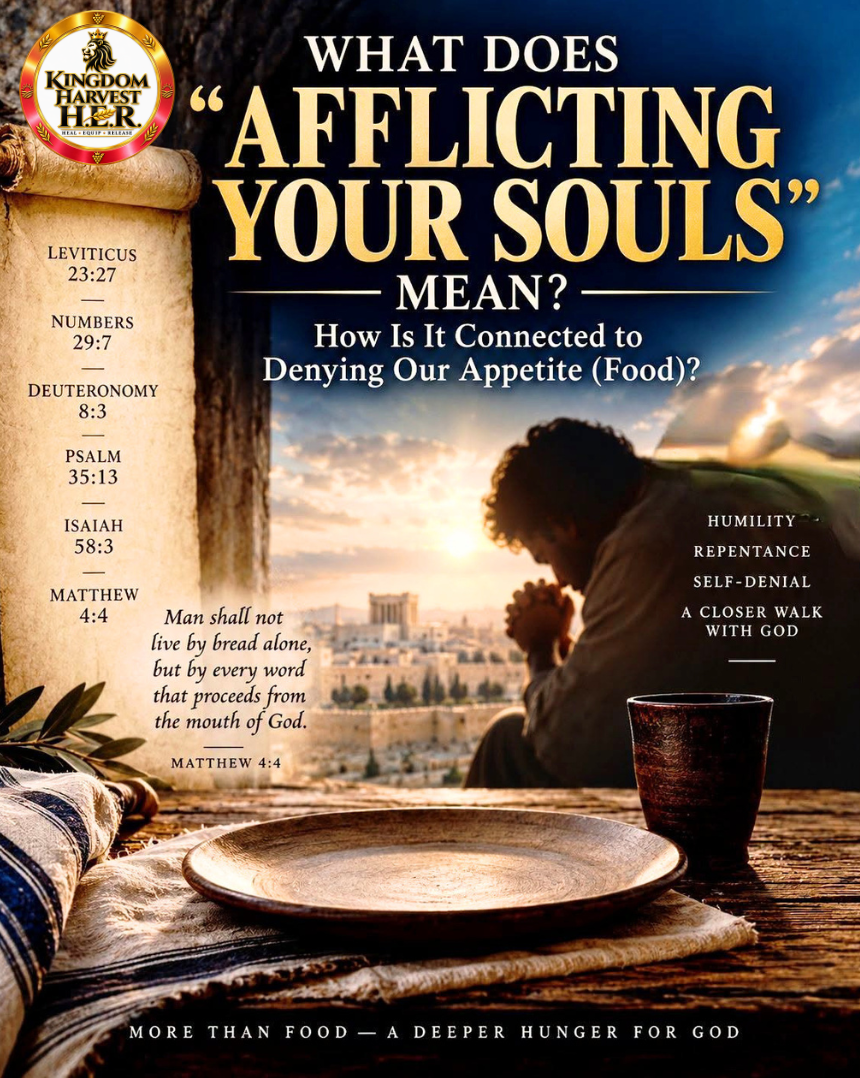
Fasting certainly belongs in the biblical picture of affliction. David said, “I afflicted my soul with fasting” in Psalm 35:13. Ezra proclaimed a fast “that we might afflict ourselves before our God” in Ezra 8:21. Prophet Isaiah also places fasting and the afflicting of the soul together in Isaiah 58. By the first century, the Day of Atonement was even commonly known as “the Fast” in Acts 27:9. So there is something very physical about this day. The body feels it. Hunger comes. Thirst comes. Normal comforts are removed. Ordinary routines stop.
But surely that physical emptiness is meant to lead us somewhere deeper, because a person can refuse food and water all day and never truly humble his heart before Yeshua. Prophet Isaiah makes that painfully clear when the Lord asks, “Is it such a fast that I have chosen? a day for a man to afflict his soul?”
The outward act by itself was not enough when the heart remained untouched. Prophet Joel gives us language that captures this beautifully when he says, “Turn ye even to me with all your heart, and with fasting, and with weeping, and with mourning: and rend your heart, and not your garments, and turn unto the Lord your God: for He is gracious and merciful” (Joel 2:12–13). Rend your heart. That is where my thoughts keep returning as I fast and commune with the Lord.
There is something almost self-abasing about Yom Kippur, but not self-destructive. It is choosing to come low. It is willingly laying aside the defenses with which we normally protect ourselves from seeing ourselves too clearly. It is saying, Yeshua, search me. Show me. Expose what I have excused. Reveal what I have ignored. Put Your finger on whatever in me does not resemble You. King David prayed, “Search me, O God, and know my heart: try me, and know my thoughts: and see if there be any wicked way in me” (Psalm 139:23–24). Lamentations says, “Let us search and try our ways, and turn again to Yeshua” (Lamentations 3:40).
So Yom Kippur is not merely hunger and it is not merely thirst. It is allowing myself to become quiet enough before Yeshua that there is nowhere left to hide.
Where am I proud? Where have I spoken carelessly? Where have I been impatient? Where have I withheld forgiveness? Where have I justified something Yeshua calls sin? Where have I become comfortable? Where have I resisted correction? Where have I grieved His Spirit? Where have I known what was right and failed to do it? Where have I failed to love? Where have I looked more carefully at the sins of another person than at my own?
There is something sobering about asking the Holy Spirit those questions sincerely, but there is also something extraordinarily beautiful about it.
Yom Kippur is not simply a day about sin. It is a day about Yahweh’s provision for sin. Leviticus 16:30 says, “For on that day shall the priest make an atonement for you, to cleanse you, that ye may be clean from all your sins before the Lord.”
While Israel afflicted themselves, Yeshua was providing the covering. The people did not create the means of atonement. King Jesus did. They did not invent the priesthood. King Jesus did. They did not determine the sacrifice. King Jesus did. They did not determine how cleansing would occur. King Jesus did. Their part was to humble themselves before Him and receive with trembling gratitude what He had provided.
THE HIGH PRIEST of our SANCTUARY
Knowing Yeshua as our great High Priest makes the picture even more overwhelming. Hebrews tells us that Messiah entered not into an earthly sanctuary made with hands, but into heaven itself, appearing in the presence of God for us (Hebrews 9:24). He entered by His own blood, having obtained eternal redemption (Hebrews 9:12). So when I think about Yom Kippur, I do not merely think about everything from which I need cleansing. I think about the breathtaking mercy of the One who provided that cleansing.
Perhaps that is also why the introspection of this day should be so deep. Grace does not make honest self-examination unnecessary. Grace makes honest self-examination possible without despair. I can ask King Jesus to expose me because I know His purpose is not to destroy me. It is to make me holy. There is a difference between condemnation and pruning. Condemnation says there is no hope. Pruning removes what is preventing fruit. King Jesus said, “Every branch that beareth fruit, he purgeth it, that it may bring forth more fruit” (John 15:2).
Perhaps that is one of the most beautiful ways to approach Yom Kippur: Lord, prune me. I am giving You access to the garden of my heart. Cut away what should not be growing there. Show me what I have allowed to take root. Show me what is stealing nourishment from good fruit. Show me where I need repentance rather than excuses. I would rather see it now. I would rather confess it now. I would rather turn now. Let me willingly bring myself low before You and listen closely enough to hear where You are correcting me.
THE WAGE OF SIN & THE POWER OF ATONEMENT
That makes Yom Kippur sobering in another way. It reminds us that sin is serious. Atonement exists because sin is serious. Blood was required because sin is serious. Repentance matters because sin is serious. Judgment is real because Yahweh is holy. But mercy is also real because King Jesus is merciful. The day therefore becomes both warning and invitation. It calls me to examine myself while at the same time reminding me that the Lord Jesus is the One who made provision for cleansing.
Once I have allowed the Lord to turn the light upon my own heart, I cannot help thinking about others. I think about Israel. I think about my family and friends. I think about those I love who do not yet know the Lord, those who know His name but remain far from Him, and those who have never understood the magnitude of the provision Yahweh has made. Apostle Paul carried this grief for Israel when he wrote, “Brethren, my heart’s desire and prayer to God for Israel is, that they might be saved” (Romans 10:1). There is something deeply fitting about carrying that same burden into a day centered upon atonement.
Yet even here, I do not want intercession for others to become a way of avoiding examination of myself. It is much easier to pray about what everyone else needs than to sit silently before the Lord and ask what He wants to change in me.
So first, search me. Then, once I remember how desperately I myself have needed mercy, I can plead for mercy for others without superiority. Lord, open their eyes. Draw them. Have mercy on Israel. Have mercy on our husbands and wives, our children, our parents, our friends, those who are wandering, and those who believe they have no need of You. Let them see King Jesus. Let them understand the atonement You have provided.
Then even the hunger of the fast begins to carry meaning. My stomach may be empty, but my heart can be full of names. The quietness created by abstaining from food and ordinary pleasures makes room for something else. The table is quiet. The kitchen is quiet. The routines are quiet. The distractions are quieter. In that stillness, perhaps we can hear more clearly.
We remember what He has brought us out of. We remember who we once were. We remember where we still need transformation. We remember what sin costs. We remember the mercy we have received. We remember those who have not yet understood that mercy. We sit before Yahweh without pretending, without rushing, without filling the silence, and allow Him to search us.
Yom Kippur therefore becomes much more to me than simply enduring a fast until sundown. It is a day to come low before Yeshua, to allow Him to search every hidden place, to confess without excuse, to repent without bargaining, to remember the terrible seriousness of sin, and to marvel at the incomprehensible gift of atonement. It is a day to thank Him for everything He has brought me out of and to ask Him to prune whatever still remains. It is a day to grieve for those who have not yet come near, to plead for Israel, and to plead for those I love.
So what are we actually commanded to do?
STOP ordinary work
HUMBLE & AFFLICT ourselves
GATHER as a holy convocation
REST as a complete Shabbat
LIVE from ATONEMENT before Adonai
Scripture speaks very seriously about both afflicting ourselves and resting from work.
Leviticus 23 says that the person who does not afflict themselves is to be cut off from the people, and that anyone who does work on that day will be destroyed from among the people.
Then Adonai gives the timeframe plainly:
“From evening to evening you are to keep your Shabbat.”
— Leviticus 23:32
So Yom Kippur is not simply a meaningful tradition or a day we observe when it is convenient. It is a commanded, set-apart day—from evening to evening—of repentance, affliction, rest, mercy, cleansing, and atonement before Him.
Most of all, it is a day for me to say, Lord, here I am. No defenses. No excuses. No hiding. Search me, know me, correct me, cleanse me, prune me, teach me, and bring every part of me into agreement with You. Never allow me to become casual about the atonement You have provided.
That is how I prepared myself for Yom Kippur. Not merely with an empty stomach, but with an open heart. Not merely abstaining from what sustains the body, but willingly placing my whole self before Yeshua Hamashiach. Because the command was never merely to afflict the stomach. Yeshua said, “Afflict your souls.” (Leviticus 16:29, 16:31, 23:27, 23:32, and Numbers 29:7)
And I want to understand the depth of what that means.
THE FALL FEASTS POINT TO KING JESUS
King Jesus’ coming fulfilled and brought rich meaning to Yom Kippur. His perfect and final sacrifice did away with the sacrificial system, but this period remains an appointed time that connects us to God’s times and seasons. It allows us to repent at God’s moed, appointed time, not because He will not forgive our sins any other day, but because this is a season where we need to draw near to God.
Ten days before Yom Kippur is Rosh Hashanah, the biblical civil new year and our awakening blast. When we reach Yom Kippur, we have just entered a new year in God, a fresh season where we can shake off the old and go higher into all God has for us through repentance and returning to Him.
This is vital preparation for our calling and relationship with God, as well as for the final Fall Feast, Sukkot, when we abide with Him. He makes us holy and cleanses us through the blood of King Jesus, so that we may abide with Him forever.
Each of these feasts holds importance, and God has placed them in this order— Rosh Hashanah , Yom Kippur & Sukkot —for a reason. We have to be awakened to the truth that we are shifting into something new. We have to be cleansed before we can dwell with God and accept our new mantles, plans, and promotion for the year 5787. We have to abide with God if we are going to have the strength and peace to answer His call.
Being a Saint does not make these feasts less important; through the blood of King Jesus, they become even more important. The substance of the feasts is KING Jesus, who came not to abolish the law but to fulfill it! Matthew 5:17 Find More Prophetic Meaning & Significance from our book - https://www.amazon.com/dp/B0HJGJXLX4
In Him, the power of what they truly point to and represent becomes clearer.
We pray that this Fall Feast season, God awakens you, redeems you, and dwells with you! We pray that through this moed you understand who you are, the roots of your faith, and most importantly, the truth of God’s purpose and plans for you.
We pray you go forward in courage, conviction, and trust, following Him into this new season and into the fullness of your Kingdom Destiny.
For King Jesus in His Lavish Grace,
Prophetess Dr.Jemi✨
Stay Connected With News, Updates Or Book Your Free Strategy Session NOW (LIMITED TIME OFFER)!
